Growing Huffaz in Unfamiliar Ground: How American Muslim Families Are Nurturing Quranic Memorization Outside the Muslim World
A Different Kind of Hifz Journey
In Cairo, Karachi, or Amman, the environment itself does much of the work. The adhan sounds publicly five times a day. Arabic fills the street. Extended family members who have memorized portions of the Quran are a phone call — or a short walk — away. The child pursuing hifz in those contexts is swimming with a current.
In suburban Ohio, or in a mid-sized Texas city where the nearest Islamic school is forty minutes away, the current runs in a different direction entirely. American Muslim parents raising children toward hifz are not simply teaching memorization. They are simultaneously constructing the cultural, linguistic, and spiritual scaffolding that other societies provide automatically. That is an enormous undertaking, and it deserves to be discussed with both honesty and respect.
The Structural Challenges Are Real
Before strategies can be meaningful, the obstacles must be named clearly.
The school schedule problem is perhaps the most immediate. American public schools operate on a calendar and daily timetable that leaves limited space for intensive religious study. A child who attends school from 8 a.m. to 3 p.m., participates in extracurricular activities, and completes homework has perhaps one or two hours of genuine cognitive bandwidth remaining. Hifz, at any serious pace, requires focused daily memorization and review — often an hour or more. Something must give, and families frequently struggle to identify what.
The linguistic environment compounds the difficulty. Arabic is not a language children in most American cities encounter outside of deliberate religious contexts. When a child in a traditionally Islamic society hears Arabic in conversation, on television, and in daily commerce, the language becomes anchored in living experience. An American child studying Arabic exclusively in a weekend Islamic school or through a hifz program must maintain a language that has no organic presence in daily life. Retention of pronunciation, vocabulary, and the feel of the language requires sustained, intentional effort from the family.
Teacher access remains a genuine constraint. Qualified hifz teachers — those with ijazah and experience working with children — are unevenly distributed across the United States. Families in major metropolitan areas with established Muslim communities, such as Dearborn, Michigan, or the greater Houston area, have access to dedicated hifz institutes. Families in smaller cities or rural areas may have no qualified teacher within reasonable driving distance.
Social pressure and peer culture operate quietly but persistently. A child who spends Saturday mornings reviewing Quranic verses while classmates are at soccer tournaments or birthday parties will, at some point, feel the weight of that difference. Parents who dismiss this tension as a test of faith without acknowledging its emotional reality miss an opportunity to support their children with genuine empathy.
What Families Who Succeed Have in Common
Across communities in the United States, certain patterns emerge among families who successfully guide children through hifz in non-Muslim environments. These are not formulas — every family's circumstances differ — but they represent recurring features worth examining.
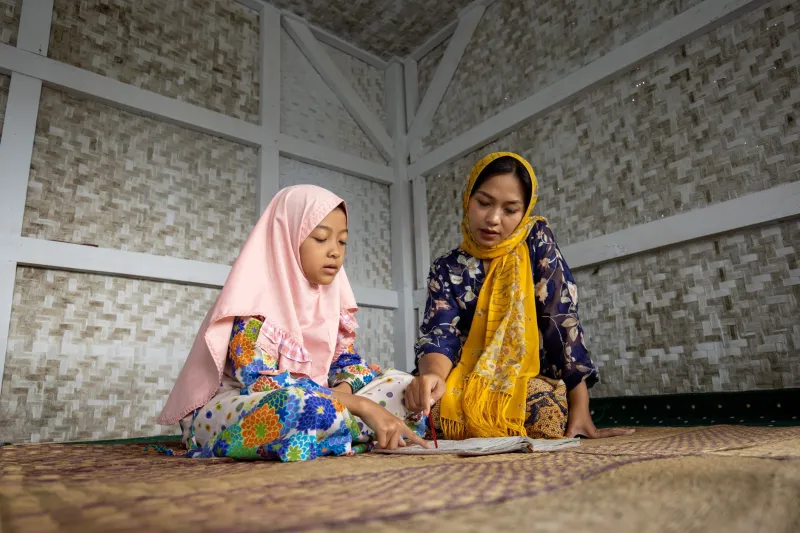
They treat hifz as a family project, not a child's assignment. In families where memorization thrives, parents are visibly engaged. They review surahs alongside their children, attend teacher check-ins, and speak about the Quran with genuine reverence in daily conversation. The child understands, through lived experience rather than instruction, that this is something the entire household values. One mother in the Chicago area described her approach plainly: "My daughter knows I'm also reviewing Juz Amma. We sit together after Fajr. It stopped feeling like homework and started feeling like something we share."
They build community deliberately. Where no ready-made hifz community exists, determined parents create one. Small home halaqas, informal weekend memorization groups organized through the local masjid, and online study partnerships with other hifz families across the country all serve this function. The social dimension of hifz — reciting before others, hearing peers recite, celebrating milestones together — is not a luxury. It is a structural support that keeps motivation alive through the long middle years of memorization.
They negotiate with institutions rather than working around them. Some families have found success engaging directly with school administrators about accommodation. Homeschooling, dual enrollment, and flexible scheduling arrangements are more common in the American educational context than many parents realize. Islamic schools that offer integrated hifz programs have expanded in recent years; families who relocate to access these institutions describe the decision as transformative.
They address the spiritual dimension honestly with their children. Children who understand why hifz matters — not merely that it is obligatory or prestigious, but what it means to carry the words of Allah in one's heart — demonstrate greater resilience when motivation flags. Parents who create space for their children to ask genuine questions about the Quran, about Islam, and about their own identity as American Muslims are building a foundation that memorization can rest upon.
Language, Identity, and the Long View
For many American Muslim families, hifz is inseparable from a broader question of identity formation. Children raised in the United States inhabit multiple worlds simultaneously — American by birth, Muslim by faith, often tied to a parental heritage culture as well. The Quran can serve as a unifying thread across these identities, but only if it is presented as living and relevant rather than as an artifact of a distant world.
Teachers and parents who connect Quranic verses to daily life — who discuss what an ayah means during a car ride, who return to a memorized surah when a family faces difficulty — help children understand that hifz is not a credential to be earned but a relationship to be cultivated.
The linguistic challenge also invites a longer view. Arabic need not be mastered before memorization can be meaningful. Many American-born huffaz have completed their memorization before achieving conversational Arabic fluency, returning to the language's depth in later years. The memorization itself, properly grounded in tajweed and basic meaning, plants seeds that continue to grow.
A Worthy and Possible Endeavor
None of this is easy. American Muslim parents pursuing hifz for their children in non-Muslim environments are doing something genuinely difficult, and they deserve acknowledgment of that difficulty alongside practical support.
But the record of Muslim communities across history is one of carrying the Quran into every kind of terrain — deserts, cities, distant continents, and now, the suburbs of a nation where the adhan is rarely heard outside the masjid walls. The families who are doing this work today are part of that long, unbroken chain.
The ground may be unfamiliar. The Quran, and the determination it inspires, is not.