Screens, Apps, and Sacred Verses: Navigating Digital Tools Without Losing the Soul of Hifz

When the Mushaf Fits in Your Pocket
For most of Islamic history, the hafiz carried the Quran in two places: the heart and, when necessary, a physical copy. Today, American Muslims carry something else entirely — a smartphone that can display any surah, recite any ayah in a dozen qira'at, and even evaluate pronunciation in real time. The digital age has placed extraordinary tools at the fingertips of every student, yet it has also introduced questions that classical scholars never had to answer: Does convenience deepen memorization, or does it quietly erode the discipline that makes hifz lasting?
These are not rhetorical questions. They are practical ones that every student, parent, and teacher navigating the modern hifz journey must confront honestly.
The Landscape of Quranic Technology in America
The market for Islamic educational technology has grown substantially over the past decade, driven in part by a large, digitally engaged American Muslim population seeking flexible learning solutions. Apps such as Quran Companion, Tarteel, and Memorize Quran Now represent a new generation of tools that go well beyond simple digital text display. Tarteel, for instance, uses artificial intelligence to listen to a student's recitation and flag tajweed errors or missed words in real time — a capability that would have seemed extraordinary even fifteen years ago.
Spaced-repetition systems, borrowed from language-learning platforms like Anki, have also entered the hifz toolkit. These systems schedule review sessions algorithmically, surfacing verses that a student is most likely to forget before they actually slip away. For busy adults balancing careers and family obligations, this kind of intelligent scheduling can mean the difference between a sustainable review routine and one that collapses under the weight of daily life.
Online platforms now connect students in Chicago or Houston with certified teachers in Egypt, Saudi Arabia, and Pakistan through live video sessions. For communities without access to a local hifz institute — and many American cities still fall into this category — that connectivity is genuinely transformative.
Where Digital Tools Genuinely Help
Honest evaluation requires acknowledging real benefits before issuing cautions. Three areas stand out where technology offers measurable advantages for hifz students.
Tajweed feedback at scale. Most students cannot access a qualified teacher every single day. AI recitation tools fill that gap by providing immediate, consistent feedback during independent practice sessions. While no algorithm fully replicates the nuanced ear of a trained sheikh, real-time error detection helps students avoid reinforcing incorrect pronunciation habits — a problem that, once entrenched, is notoriously difficult to correct.
Structured review for the adult learner. The traditional model of hifz assumed a student with long, uninterrupted hours — typically a child in a residential madrassa setting. American adults memorizing part-time have a fundamentally different relationship with time. Spaced-repetition scheduling, integrated into apps and calendar tools, adapts to fragmented schedules in a way that rigid traditional timetables cannot.
Community and accountability. Several platforms now offer group memorization challenges, progress tracking visible to a study partner, and online halaqas where students recite to one another. For Muslims living in areas with small Muslim populations, this virtual community can replicate some of the social accountability that traditional hifz environments provide naturally.
Where the Risks Accumulate
The same features that make digital tools powerful can, if misused, undermine the very foundations of solid memorization.
The most significant risk is what might be called passive familiarity masquerading as memorization. When a student listens to a recitation app repeatedly without actively closing the screen and reciting from memory, the brain receives input without generating the effortful retrieval that builds durable retention. Neuroscience is clear on this point: the act of struggling to recall — not the act of re-reading or re-listening — is what strengthens memory traces. An app that makes it too easy to hear the answer before the student has genuinely attempted recall is, in effect, short-circuiting the learning process.
Screen dependency presents a related challenge. Students who always have a digital text available may never develop the internal visualization of the page — the spatial memory of where a verse sits on a mushaf — that many experienced huffaz describe as central to their long-term retention. The physical mushaf, with its consistent Uthmani script layout, trains the eye and mind in ways that scrollable digital text, which can reformat dynamically, does not replicate.
Finally, the abundance of features in modern apps can become a form of productive-feeling procrastination. Customizing settings, exploring recitation styles, and logging statistics are all activities that feel like hifz work without constituting actual memorization.
A Framework for Thoughtful Integration
The goal is not to reject modern tools but to subordinate them to a coherent methodology. The following principles offer a practical framework.
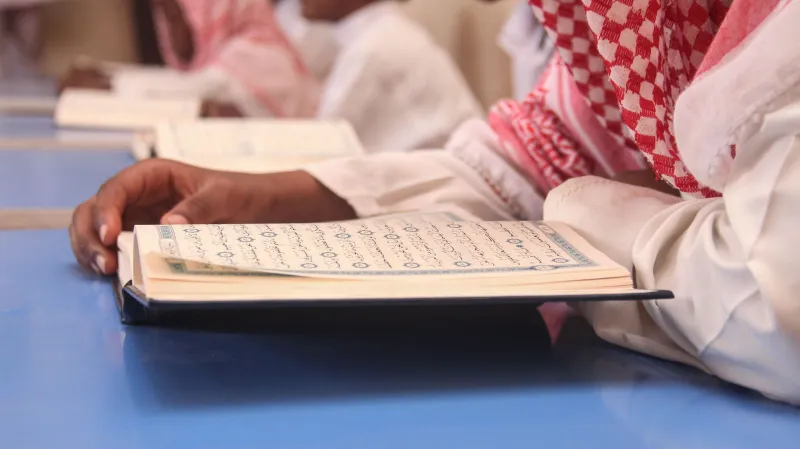
Establish the mushaf as the primary text. Conduct new memorization sessions exclusively with a physical mushaf, specifically the Madinah-print edition most widely used in hifz circles. Reserve digital text for travel or situations where carrying a physical copy is genuinely impractical.
Use AI feedback as a supplement, not a substitute. Run recitation-checking apps during independent practice, but ensure that a qualified human teacher reviews your recitation at regular intervals. The relational dimension of sitting before a sheikh and reciting carries spiritual and pedagogical weight that no algorithm can replicate.
Treat spaced-repetition scheduling as infrastructure, not as the lesson itself. Let algorithms tell you when to review; do the actual review with your mushaf closed and your voice engaged.
Set screen-free memorization windows. Designate at least one daily session — ideally the Fajr period, when the mind is clearest — as entirely screen-free. This protects the contemplative, unhurried quality that deep memorization requires.
The Classical Wisdom That Anchors Everything
The scholars who developed the traditional hifz curriculum understood something that no app has yet encoded: memorization of the Quran is an act of worship before it is an academic exercise. The barakah associated with sitting with a teacher, with handling the mushaf with wudu, with reciting in the quiet hours before dawn — these dimensions of the practice are not incidental. They are constitutive of what hifz means.
Digital tools, used wisely, can extend a student's reach and sharpen specific skills. But they are instruments in service of a sacred endeavor, not the endeavor itself. The modern Muslim who learns to hold that distinction clearly will find that technology becomes a genuine asset rather than a subtle distraction.
The Quran has always found its way into new hearts across changing centuries and shifting civilizations. The screens in our pockets are simply the latest terrain through which that journey continues.